


Best Rugs for Homes With Pets: What Survives Claws, Fur and Accidents
There are 11.1 million dogs and 10.5 million cats living in UK homes, according to the PDSA Animal Wellbeing Report. A good number of them are quietly destroying a rug right now.
The usual advice is to buy something "durable", which tells you nothing. This guide is more specific. It covers which fibres actually survive claws, which patterns genuinely hide fur (it is not the one you think), what "machine washable" means once you check your own machine's capacity, and what to put down for each particular problem you have.
I have put real prices and real sizes against everything, including the places where our own range is the wrong answer.
What makes a rug genuinely pet-proof? Three things, in this order 🐾
A tight low pile, a surface that breaks up the colour of fur, and a backing that does not slide. Get those three right and almost any fibre will cope. Get them wrong and the most expensive rug in the room will look tired inside a year.
Here is why each one matters, in the order it will affect your daily life.
Pile height decides how much hair you own. Fur does not sit on top of a rug, it works its way down between the fibres, and the deeper the pile the further it goes. Below about 10 mm a vacuum lifts almost all of it in one pass. At 25 mm or more you are brushing as well as vacuuming, every time.
Surface pattern decides how often you care. This is the one most people get backwards, and there is a whole section on it below.
Backing decides whether the rug survives the running. A dog taking a corner at speed on a loose rug will ruck it up, slide it into the skirting board and eventually tear the weave at the fold. An integrated non-slip back, or a separate pad, stops all of that. It also stops your pet skidding, which matters more for older or larger dogs.
Pet owners tend to shop for stain resistance. In practice, hair is the daily problem and stains are the occasional one. Buy for the hair.
Which rug materials survive dogs and cats best? 🧵
Polypropylene and recycled PET are the most forgiving, wool is excellent but needs you to act fast on accidents, and viscose has no business being in a home with animals.
That ranking is about behaviour under claws and liquid, not about quality. A good wool rug is a better object than a polypropylene one. It is simply less tolerant of being weed on.
| Fibre | Claws | Accidents | Verdict for pets |
|---|---|---|---|
| Polypropylene | Very good | Excellent, fibre is not absorbent | The safe default |
| Recycled PET | Very good | Excellent, often fully washable | Best of both, wool-ish look |
| Wool | Good, springs back | Risky, urine sets permanently | Fine for adult, house-trained pets |
| Jute and sisal | Poor, cats shred it | Poor, holds odour | Avoid where accidents happen |
| Viscose and silk | Very poor | Very poor, water alone marks it | Do not |
Two of those deserve a note. Jute surprises people, because it looks rugged. It is rugged underfoot and hopeless with liquid: the fibres drink it, the odour stays, and you cannot wet-clean it without risking the weave. We go into that in our guide on cleaning a jute rug and what not to do. If you love the look, keep it out of the rooms where accidents actually happen and browse the natural material rugs for a hallway instead.
Viscose is sold under prettier names, including art silk, bamboo silk, banana silk and rayon. All the same fibre. It loses strength when wet, so a single accident leaves a permanent stiff patch. It appears in a lot of very attractive budget rugs, which is exactly why it catches people out. If a rug is unusually shiny for its price, check the composition before anything else. Our piece on wool versus synthetic rugs in real life goes deeper on the trade.
Does "machine washable" actually mean your machine? 🧺
Usually only up to about 120 x 170 cm. Above that, a washable rug is still washable, just not by you at home. This is the single most common disappointment in the washable rug category and almost nobody says it plainly, so here it is plainly.
The limit is not the drum size, it is the weight once the rug is wet. A rug that slides into the machine dry can be two or three times heavier saturated, which trips the load limit, throws the spin cycle out of balance and puts real strain on the bearings. Dunelm rates its washable range to 120 x 170 cm on an 8 kg to 10 kg machine, and Ruggable's own guidance puts a standard 8 kg to 9 kg domestic machine at roughly 150 x 215 cm maximum. Those two numbers bracket the honest answer.
Against the sizes we actually sell, that works out as follows.
Wash temperature is worth checking too, because it is not standard across the category. Our Washable Marrakesh is rated to 30 °C with a line dry, while the My Rug Fleck takes 40 °C. If you have a pet with a tendency towards accidents, that ten degrees is the difference between a wash that deals with the smell and one that merely moves it around. Either way, read our guide to getting smells out of a rug before you resort to the machine.
Before you buy any washable rug, check one number. Not the rug's. Yours. Open your washing machine door and look for the capacity on the rim or the inside of the door, usually 7 kg, 8 kg or 9 kg. Then buy a rug size the chart above says that drum can take. It takes ten seconds and it is the difference between a rug you maintain and a rug you resent.
Which colours and patterns actually hide fur? 🎨
A fleck, heather or mottled weave beats both a plain colour and a busy print. This is the part most guides get wrong, including the earlier version of this one.
The standard advice is "dark colours for dark pets, light for light". That is half right and leads people to buy plain rugs, which are the worst case. A single flat colour gives every stray hair a clean edge to show up against. A busy, high-contrast print is better, but busy prints have their own problem: they hide dirt so well that you stop noticing it, which is not the same as the rug being clean.
What works best is a surface with many closely related tones at low contrast, a fleck or a heather. Hair reads as one more speck among hundreds, so it genuinely disappears at standing height, and you can still see mud when there is mud. This is the same principle behind commercial carpet in hotel corridors, and it is not an accident that those are mostly flecked.
The second rule is to match the rug to the animal, not to the sofa. A golden retriever on charcoal is a losing battle no matter how good the weave is. If you have one light pet and one dark pet, go mid-tone and flecked and accept the compromise. Our grey rugs and beige rugs are the usual landing spots for that; the charcoal rugs work beautifully with a black cat and show up every hair of a cream one.
What should you never put down in a home with pets? 🚫
Loop pile, long fringe, viscose, and any shag over about 30 mm. Each of those fails for a different reason, and three of the four are about claws rather than mess.
Loop pile is the big one. A cut pile is thousands of loose fibre ends, and a claw passes straight through. A loop pile is thousands of little handles. One caught claw pulls a loop, the pull runs, and you get a ladder across the rug that cannot be repaired invisibly. If you have a cat, this single check matters more than the fibre.
Long fringe is a toy. To a kitten it is unambiguously a toy. Short knotted fringe is usually survivable, the decorative 10 cm kind is not.
Deep shag traps everything and stops releasing it. Fur, dander, dust and moisture go in and a domestic vacuum does not get them out, so the rug slowly becomes the thing in the room that smells. If someone in the house has an allergy this is worth taking seriously. Save the shag for a bedroom the animals do not get into, and look at bedroom rugs with that in mind.
Worth saying clearly: a hand-knotted wool rug is not on this list. Good wool is more resilient under claws than most synthetics, because the crimp in the fibre lets it spring back. Its weakness is specifically urine, which sets in the fibre and in the foundation and is a professional job once it has dried. If your pets are adult and reliable, a proper Persian rug is a perfectly sensible thing to own. If you are house-training a puppy this year, wait a year.
Seven rugs we stock for pet homes, and who each one is for 🛋️
These are picked against the five problems in the chart above, not by price. Prices are the current starting size and all seven are in stock as this is written.

Best for heavy shedding
My Rug Fleck Blue
The fleck does exactly what the section above describes: a navy base shot through with lighter specks, so hair stops reading as hair. Recycled polypropylene, stain resistant, washable at 40 °C. Be aware the pile is 25 mm, so it is a comfort rug rather than a low-maintenance one. It hides fur brilliantly and still holds more of it than a flatweave would.
From £23.92 (60 x 100 cm, nine sizes including round)

Best all-rounder
Origins Washable Marrakesh
If you only read one entry, read this one. Low-profile chenille on a TPR backing with integrated non-slip, washable at 30 °C, in a distressed medallion that is busy enough to forgive a lot. It ticks pile, pattern and backing in one product, which almost nothing at this price does. The 67 x 200 cm runner is the size to buy for a hallway.
From £33.30 (runner 67 x 200 cm, up to 160 x 230 cm)

Best for cats and claws
Origins Highland Check Navy
A flatweave in 100% recycled PET, which is the construction with nothing for a claw to catch. Navy and grey check, washable, with a wool-like look and none of wool's sensitivity to accidents. The fringe is short and knotted rather than long and loose, which is the version cats tend to leave alone.
From £63.44 (80 x 150 cm, up to 200 x 290 cm)

Best for a light-coated pet
Origins Washable Chateau Neutral Trellis
Cream and golden retriever hair against a neutral trellis is close to invisible, and the fine repeating pattern does the low-contrast job a plain beige cannot. Washable, non-slip, and deliberately quiet, so it works in a room you did not want to hand over to the dog aesthetically.
From £34.97 (multiple sizes and a runner)

Best for back doors and muddy routes
Origins Granada Washable Ruby Red
Rated for indoor and outdoor use and for high traffic, which in practice means the strip of floor between the back door and the kitchen. Deep red with a faded vintage pattern, so mud has to try quite hard to be visible. Washable, and cheap enough that you are not precious about where it goes.
From £37.96 (see also the outdoor rugs)

Best if you want the Persian look anyway
Sovereign Medallion Charcoal
A traditional medallion in a flatweave polyester, tagged easy clean and high traffic. You get the detail and the formality of a classic Persian design with none of the urine anxiety that comes with real wool, and charcoal with a dense pattern is about as forgiving as a dark rug gets. Goes up to 240 x 330 cm, which is the size most living rooms actually want.
From £129.00 (up to 240 x 330 cm)

The cheapest thing that helps most
My Mat Navy Border Stripe Coir Doormat
Not a rug, and genuinely the highest-value purchase on this page. Coir is stiff enough to scrape a paw, which is the one thing a soft rug cannot do. Stopping mud at the door is far easier than removing it from a rug afterwards. £15.99 against the price of replacing the rug it protects is not a close call.
£15.99 (45 x 75 cm, more in doormats)
Where else do UK pet owners buy, and what is each place good at? 🛒
We are not the only place to buy a pet-proof rug and it would be odd to pretend otherwise. Here is an honest read on the main options, including where we are the wrong choice.
Amazon has the deepest range and the fastest delivery, and it is the worst place to judge a rug. You cannot tell a 25 mm pile from a 10 mm one in a styled photograph, listings routinely describe polypropylene as "wool feel", and returning a 160 x 230 cm rug through a locker is nobody's idea of a good afternoon. Where it genuinely wins is everything that goes with the rug, which we do not sell at all: a rubber rug rake lifts embedded hair that a vacuum will not, an enzyme stain remover is the only thing that actually breaks down the proteins in urine rather than masking them, and a washable non-slip rug pad solves the sliding problem under a rug that has no backing of its own. Buy those there. Buy the rug where you can see its specification.
Dunelm, Argos and IKEA all carry washable ranges now, and the real advantage is that you can go and stand on one. If you are uncertain about pile height, half an hour in a shop is worth more than any guide, including this one. The trade is a narrow set of sizes, designs that turn up in a lot of houses, and very little information about construction on the ticket.
Ruggable built the washable category in the UK and its two-piece system, a thin top that peels off a grippy pad, is a genuinely clever answer to the weight problem in the chart above. It is also the most expensive way to solve this, and the thin top layer feels noticeably less substantial underfoot than a woven rug. If your main problem is frequent accidents and you have the budget, it is a serious option.
Independent rug specialists, us included, tend to win on size options, on actually publishing the fibre, pile and wash temperature, and on there being a person to ask. Where we are the wrong choice: if you want to see and touch before buying, go to a shop. If you need one very large washable rug rather than two small ones, Ruggable's system handles that better than anything in our range. And if you want a hand-knotted wool rug while you are still house-training a puppy, we would rather you waited and bought it next year.
For the independent end of that comparison, we keep a longer piece on the best online shops to buy Persian rugs in the UK, and our guide to evaluating a rug before you buy online applies wherever you end up shopping.
How do you stop a cat shredding the corners? 🐈
Give it something better to scratch within about a metre of the thing it is scratching now, and choose a weave with nothing to catch. Moving a scratching post to the other side of the room does not work, because the cat is scratching there for a reason.
Scratching is not misbehaviour, it is territorial marking and claw maintenance, and the RSPCA's guidance on cat behaviour is clear that you redirect it rather than stop it. A sisal post next to the rug corner that is taking the damage, plus a flatweave rather than a loop pile, resolves most cases. We have a full piece on how to stop a cat scratching rugs that goes through the weave side in detail.
For dogs, the equivalent problem is digging and skidding rather than scratching, and both are usually solved by a non-slip backing plus more exercise. Dogs Trust has sensible free training guidance if the digging is anxiety rather than boredom.
How do you deal with an accident before it becomes permanent? 💧
Blot, never rub, and get an enzyme cleaner on it within the hour. The window matters more than the product. Urine is roughly neutral when it lands and turns alkaline as it dries, and it is the dried alkaline salts that bond to the fibre and leave both the yellow mark and the smell that comes back every humid day.
Press a dry towel down hard and lift. Repeat with a fresh towel until it comes up dry. Then use an enzyme cleaner, which digests the proteins, rather than a detergent, which just lifts the colour and leaves the smell for your pet to find again later. Do not use a steam cleaner on a protein stain, because the heat sets it.
We have step-by-step guides for the specific jobs: getting dog urine out of a rug, removing odours, blood, fresh and dried, and cleaning a rug without a machine for everything that cannot go in one.
On hair, the trick worth knowing is that a rubber-bladed brush pulled across the pile lifts far more than a vacuum does, because the friction generates enough static to drag embedded hair up out of the weave. The demonstration below is from car detailing rather than rugs, which is why it is a good one: the surfaces are the same problem and the technique transfers exactly. Our own list of ten ways to remove pet hair from rugs covers the rest.
A rubber brush and a vacuum, on exactly the kind of embedded hair a rug collects.
If you are buying a vacuum specifically for pet hair, Which? tests them independently, and the Carpet and Rug Institute's Seal of Approval programme separately tests vacuums and cleaning products for how much soil they actually remove. Both are more useful than a manufacturer's own claim.
So what would I actually buy? ✅
Four lines, for the person who has read enough.
One pet, occasional mess: the Washable Marrakesh in the biggest size your washing machine can take, plus a coir doormat at whichever door the garden is behind.
A cat that scratches: the Highland Check flatweave and a sisal post a metre from the corner it has claimed.
A heavy shedder: anything flecked, and My Rug Fleck if you want softness with it.
A living room you still want to look like a living room: Sovereign Medallion Charcoal, up to 240 x 330 cm, and keep the wool for a room with a door.
Whatever you choose, buy the size the room wants rather than the size that feels safe. Our UK rug size guide has the measurements, and the affordable rugs and sale collections are the sensible place to start if this is the first rug you are putting down with a new animal in the house.
Pet rug questions, answered 💬
What is the best rug material for dogs?
Polypropylene or recycled PET, in a low pile, with a non-slip backing. Both resist claws, neither absorbs liquid, and many are machine washable. Wool is a good second choice for an adult, house-trained dog, but urine sets permanently in wool and needs professional cleaning once dry.
Are washable rugs safe for big dogs?
Yes, provided the rug has a non-slip backing and reinforced edges. The thing to check is not the dog's size but the rug's: a large dog usually means you want a large rug, and a rug over about 120 x 170 cm will not fit a domestic washing machine. Two runners or two smaller rugs in the places that take the damage is often the better answer than one large rug you cannot clean.
Which rug colour hides pet hair best?
A mid-tone fleck or heather weave with several closely related colours, rather than any single flat colour. Plain rugs show every hair because each one has a clean edge to contrast against. If you have to pick a solid shade, match it to your pet's coat rather than to your furniture.
How often should I vacuum a rug if I have pets?
Two or three times a week on a low pile, more if someone in the house has an allergy, since it is dander rather than hair that triggers most reactions. Spot-clean accidents immediately, and deep clean every two to three months, or monthly with multiple heavy-shedding pets.
Can a rug make pet odours worse?
A deep shag or an untreated natural fibre can, because both absorb moisture and hold it in the pile and the backing. A low pile synthetic does the opposite. If a rug already smells on a humid day, the moisture is in the backing rather than the surface, and surface cleaning will not fix it.
Will a cat ruin a wool rug?
Not usually by scratching, because wool's crimp lets the pile spring back better than most synthetics. The real risks are a loop pile, which a claw can ladder, and long fringe, which is a toy. A cut-pile wool rug with a short fringe, in a home with a litter tray the cat actually uses, is generally fine.
Is a rug pad worth it with pets?
Yes, and it is the cheapest upgrade available. It stops the rug rucking up when an animal takes a corner at speed, which is what tears the weave at the fold; it stops your pet skidding; and it adds a cushioning layer that absorbs wear. Some washable rugs have a non-slip backing built in, in which case you do not need a separate one. Our guide on how to stop a rug moving covers both cases.
Prices and sizes were correct when this was written and are updated when stock changes. Delivery is free over £50 to the UK, and returns are accepted within 30 days. Questions about a specific rug and a specific animal are welcome, and we would rather talk you out of the wrong rug than sell you one.
Best sellers
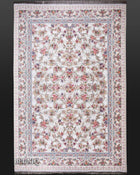 Karen Ivory & Rose Persian-Style Floral Low-Pile Acrylic Rug
Product Overview
Karen offers a contemporary...from £195.00
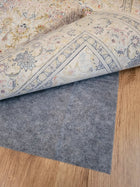 Cushioned Anti-Slip Rug Underlay for Hard Floors – Grey Rug Pad
Product Overview
Keep your rugs securely in ...£16.00
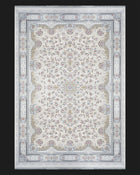 Allure Cream Persian-Style Floral Low-Pile Acrylic Rug
Product Overview
Allure Cream reimagines the...£366.00
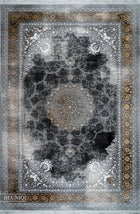 Palace Charcoal & Silver Distressed Medallion Rug 90181
Product Overview
Palace 90181 offers a conte...from £70.00
Persian rugs
Karen Ivory & Rose Persian-Style Floral Low-Pile Acrylic Rug
Product Overview
Karen offers a contemporary...from £195.00
Palace Charcoal & Silver Distressed Medallion Rug 90181
Product Overview
Palace 90181 offers a conte...from £70.00
Allure Cream Persian-Style Floral Low-Pile Acrylic Rug
Product Overview
Allure Cream reimagines the...£366.00
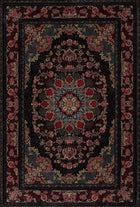 Shiraz Oriental Area Rug – Brown & Red
Product Overview
The Oriental Area Rug blend...from £97.00


Leave a comment